
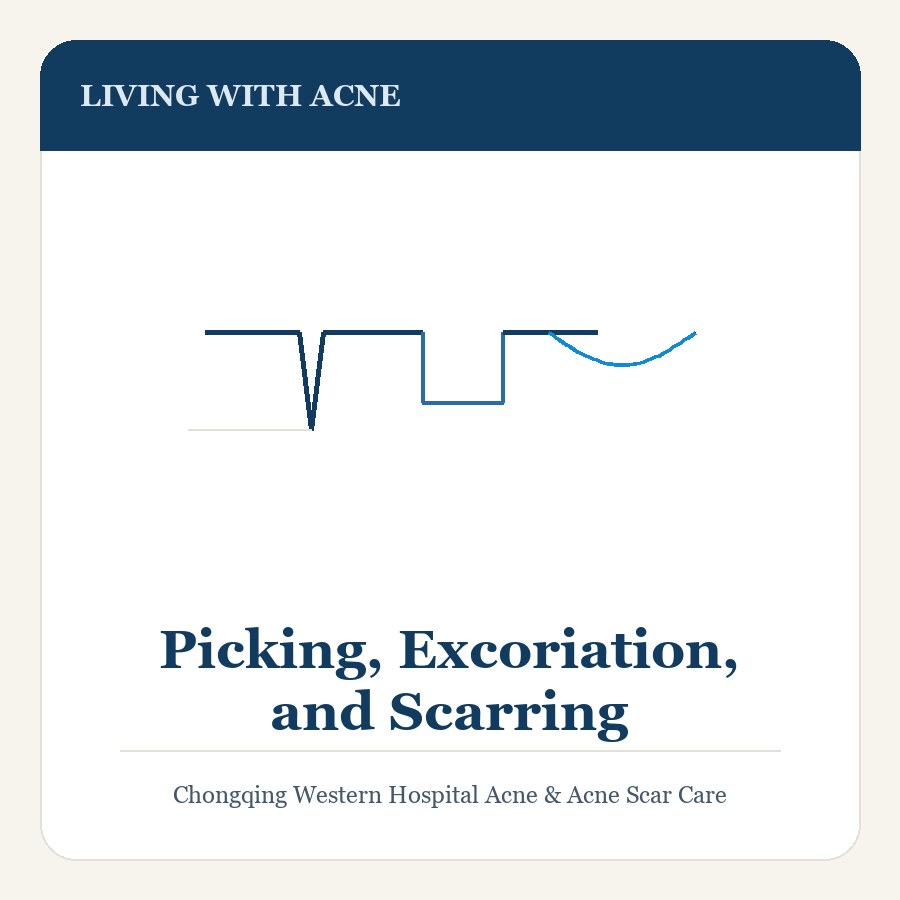
In short. Why hands-off matters: how picking turns a temporary pimple into a permanent scar, and what helps when the habit is difficult to stop.
Key points
- If picking is frequent, difficult to control, causes significant skin damage, or is tied to anxiety or low mood, it deserves proper assessment.
- Treatments exist, including psychological approaches that specifically target skin-picking behaviour, and they work better than willpower alone.
- Asking for help with the habit is a legitimate part of acne care, not an admission of failure.
Of everything that influences whether acne leaves permanent damage, the hands are the most underrated. A pimple left alone usually settles within days and may leave only a mark that fades. The same pimple squeezed, scratched, or picked at can push inflammation deeper, prolong healing, introduce bacteria, and produce a scar that never fully goes away. Much of the scarring that dermatologists treat is the result of handling rather than of the acne itself.
What picking actually does
An inflamed acne lesion has a structural weak point. Squeezing raises the pressure inside a pore that is already inflamed, and the contents can rupture into the surrounding dermis instead of out through the surface. That spreads inflammation, and inflammation is what destroys collagen and creates a dent. Picking also removes the top of a healing lesion, restarting the clock on repair, and it introduces bacteria from fingers and nails. The result is a lesion that is redder, lasts longer, and is more likely to leave both a mark and a scar.
Why the habit is hard to stop
Picking is rarely a simple habit. It is often triggered by stress, boredom, or anxiety, and it can become a repetitive behaviour with a strong urge behind it. For some people the urge to pick at the skin is part of a recognised condition, and the skin damage it causes is a medical problem rather than a matter of discipline. Acne itself increases the tendency, because texture and visible spots invite attention. Criticising yourself about it usually increases the behaviour rather than reducing it.
What actually helps
Control the acne effectively, because there is far less to pick when the skin is quiet. Keep nails short. Keep hands occupied when the usual triggers appear. Notice the situations in which picking happens, such as in front of a mirror at night, and change what you can: better lighting, a time limit, or covering the mirror. If a lesion is genuinely painful or keeps refilling, that is information for your clinician, not for your fingers.
When to ask for more than advice
If picking is frequent, difficult to control, causes significant skin damage, or is tied to anxiety or low mood, it deserves proper assessment. Treatments exist, including psychological approaches that specifically target skin-picking behaviour, and they work better than willpower alone. Asking for help with the habit is a legitimate part of acne care, not an admission of failure.
The honest arithmetic
A pimple lasts days. A mark from that pimple can last months. A scar from that pimple is permanent, and treatment can improve it but not erase it. That arithmetic is the whole argument for keeping hands off, and it holds regardless of how satisfying the squeeze feels at the time.
Arrange assessment if
- Picking is frequent or difficult to control, or it is causing wounds, scabs, or new scars.
- Skin damage is occurring alongside anxiety, low mood, or other repetitive behaviours.
- Dents or raised scars are already present — scar treatment has its own options and its own timing.
Frequently asked questions
Why does squeezing a pimple make it worse?
Squeezing raises the pressure inside a pore that is already inflamed, so the contents can rupture into the surrounding dermis instead of out through the surface. That spreads inflammation, and inflammation is what destroys collagen and creates a dent.
What helps when I cannot stop picking at my skin?
Control the acne effectively, because there is far less to pick when the skin is quiet. Keep nails short, keep hands occupied when triggers appear, and change the situations where picking happens. If it is difficult to control, psychological approaches that target skin-picking work better than willpower alone.
Can a picked spot leave a permanent scar?
A pimple lasts days, a mark from that pimple can last months, and a scar from it is permanent, with treatment that can improve but not erase it. That arithmetic holds regardless of how satisfying the squeeze feels at the time.
Risks & Limitations
- Most chronic skin disease is managed rather than cured, and relapse is expected.
- Treatments typically need 8–12 weeks before response can be judged fairly.
- Topical treatment can cause irritation, dryness, peeling and photosensitivity.
- Systemic therapy may require blood monitoring and carries organ, metabolic and pregnancy risks.
- Isotretinoin in particular requires strict monitoring and pregnancy prevention.
- Pigment change is often slow and may be incomplete.
- No treatment works for everyone, and response cannot be predicted with certainty.
When to Seek Care
- A mole or lesion that changes in size, shape or colour, or starts to bleed, itch or crust.
- Fever with a widespread rash, blistering, or rash involving the eyes, mouth or genitals — seek emergency care.
- Rapidly spreading redness, swelling or pain in the skin.
- Facial swelling or difficulty breathing — possible severe reaction; seek emergency care immediately.
- New or worsening symptoms while taking a monitored medication.
References & Further Reading
- American Academy of Dermatology (AAD) — public and clinical guidance
- World Health Organization (WHO) — skin and infectious disease resources
- Chinese Medical Association, Dermatology Branch — clinical guidance
- Cochrane Library — systematic reviews in dermatology
This page is patient education, not medical advice, and it does not cite individual studies. Discuss your own case with a qualified clinician. To arrange an assessment at Chongqing West District Hospital, see Contact & Consultation.