
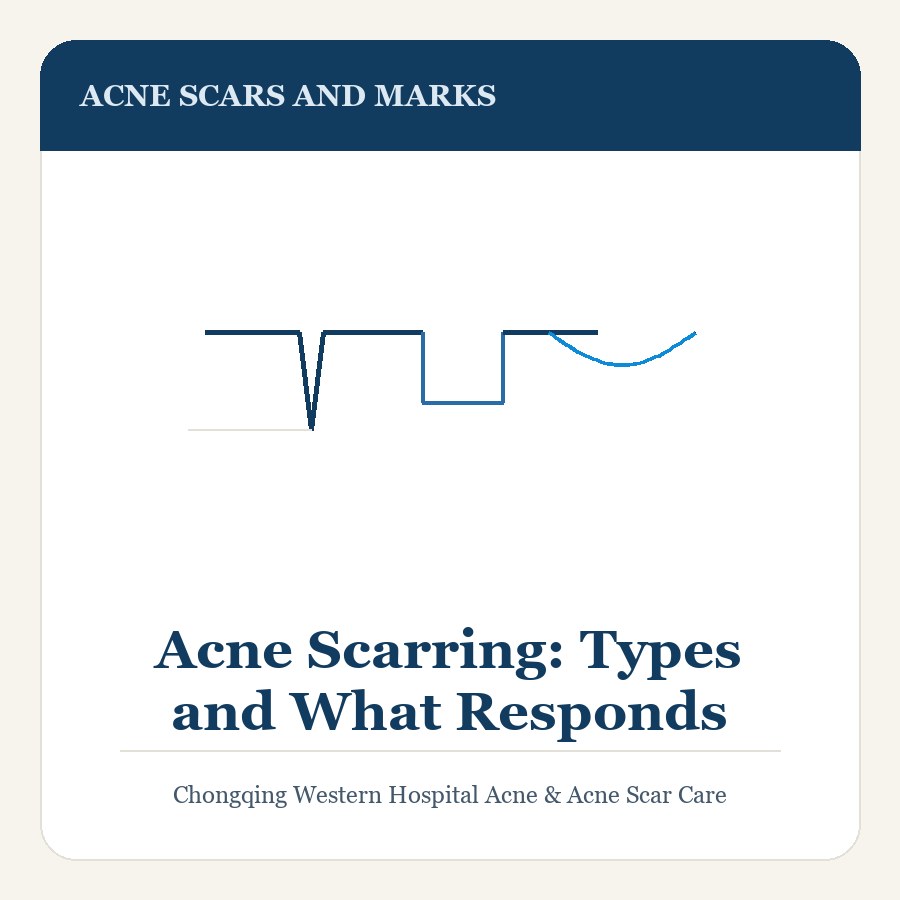
In short. Acne scarring is the structural change acne leaves when collagen is lost or overproduced, while acne marks are flat colour left by inflammation. Marks fade over months with time and sun protection; true scars, whether indented or raised, improve only partly with treatment. Control active acne first, because new lesions keep creating new damage.
Key points
- Marks are flat colour; scars are structural change, either a dent or a raised lump.
- Atrophic scars are indented and fall into icepick, boxcar and rolling types.
- Hypertrophic and keloid scars are raised, firm and more common on jawline, chest and back.
- Marks respond well and fade; true scars respond only partly to treatment.
- Control active acne before scar treatment, because new lesions create new scars.
What is the difference between an acne mark and a scar?
After acne settles, the skin often keeps a record, and the records are not all the same. Red marks and brown marks are colour left behind by inflammation; they fade with time, protection and treatment. True scars are structural changes in the skin, either a dent where collagen was lost or a raised lump where collagen was overproduced. Confusing the two leads to the wrong treatment and to unnecessary disappointment, because marks respond well and scars respond only partly.
The mechanism behind a dent or a lump
Post-inflammatory erythema is the red or purple discolouration that follows inflamed lesions. It is caused by dilated vessels and lingering inflammation, and it can persist for months after the acne has gone. Post-inflammatory hyperpigmentation is brown pigment deposited in healing skin, and it is more prominent and longer-lasting in darker skin tones. Neither is a scar. Both improve with time and sun protection, and both can be accelerated by appropriate treatment.
Atrophic scars are depressions. Icepick scars are narrow and deep, boxcar scars have defined vertical edges, and rolling scars are broad and wave-like, tethered to deeper tissue. They form because inflammation destroyed collagen and the skin could not rebuild its support. Hypertrophic and keloid scars are the opposite: raised, firm, sometimes itchy or tender, and more common on the jawline, chest, shoulders and back, and in darker skin.
Which scar types does acne leave?
| Mark | Atrophic scar | Raised scar | |
|---|---|---|---|
| What it is | Flat colour from inflammation | Dent where collagen was lost | Lump where collagen was overproduced |
| How it forms | Vessels stay dilated, or melanin is deposited | Inflammation destroys support | Collagen is overproduced in healing |
| How it looks | Red, purple or brown; follows past lesions | Icepick, boxcar or rolling | Raised, firm, sometimes itchy or tender |
| Usual site | Where the lesions sat | Where deep lesions were | Jawline, chest, shoulders and back; darker skin |
| What helps | Time, sun protection, pigment- or vessel-directed care | Microneedling, fractional laser, focal chemical reconstruction, subcision, selected fillers | Silicone, intralesional injection, laser |
| Realistic outcome | Fades over months | Improves but is not erased | Responds; surgery only in specific cases |
What does each type respond to?
Marks respond to time, sun protection and treatment directed at pigment or at blood vessels. Atrophic scars respond to treatments that rebuild or release collagen: microneedling, fractional laser, focal chemical reconstruction, subcision, and fillers in selected cases, usually in combination. Raised scars respond to silicone, intralesional injection and laser, with surgery reserved for specific situations under a scar-prevention protocol.
Why the acne must be controlled first
Control the acne first. Treating scars while new lesions keep forming means repairing damage that is still being created. Once the acne is quiet, treatment is planned around the mix of scar types actually present. Results accumulate over a course of sessions spaced weeks apart, with the honest expectation that skin improves rather than returning to how it looked before the acne began.
How long scar treatment takes
Scars mature for six to twelve months after the inflammation stops, and skin needs to recover between treatment sessions. That makes scar treatment a project measured in months rather than a single appointment. It also means that early, decisive acne treatment is the scar treatment that matters most, because a scar that never forms never needs treating.
When should a scar be assessed?
- Acne is still active while scars are forming, because stopping new damage comes before treating old damage.
- A scar is raised, growing beyond its original boundary, or itchy and painful.
- You are considering scar treatment without a plan for controlling the underlying acne.
Sources
- American Academy of Dermatology: acne scars and treatment information
- British Association of Dermatologists: patient information on acne scarring
- NICE: guidance on the management of acne vulgaris
Internal links
Frequently asked questions
What is the difference between an acne mark and an acne scar?
Marks are colour left behind by inflammation, and they fade with time, protection and treatment. True scars are structural changes, either a dent where collagen was lost or a raised lump where collagen was overproduced. Confusing the two leads to the wrong treatment and to unnecessary disappointment.
What are the main types of acne scar?
Atrophic scars are depressions: icepick scars are narrow and deep, boxcar scars have defined vertical edges, and rolling scars are broad and wave-like, tethered to deeper tissue. Hypertrophic and keloid scars are raised and firm, and are more common on the jawline, chest, shoulders and back.
What treatment do acne scars respond to?
Atrophic scars respond to treatments that rebuild or release collagen, including microneedling, fractional laser, focal chemical reconstruction, subcision and, in selected cases, fillers. Raised scars respond to silicone, intralesional injection and laser. Results accumulate over a course of sessions rather than one appointment.
Risks & Limitations
- Most chronic skin disease is managed rather than cured, and relapse is expected.
- Treatments typically need 8–12 weeks before response can be judged fairly.
- Topical treatment can cause irritation, dryness, peeling and photosensitivity.
- Systemic therapy may require blood monitoring and carries organ, metabolic and pregnancy risks.
- Isotretinoin in particular requires strict monitoring and pregnancy prevention.
- Pigment change is often slow and may be incomplete.
- No treatment works for everyone, and response cannot be predicted with certainty.
When to Seek Care
- A mole or lesion that changes in size, shape or colour, or starts to bleed, itch or crust.
- Fever with a widespread rash, blistering, or rash involving the eyes, mouth or genitals — seek emergency care.
- Rapidly spreading redness, swelling or pain in the skin.
- Facial swelling or difficulty breathing — possible severe reaction; seek emergency care immediately.
- New or worsening symptoms while taking a monitored medication.
References & Further Reading
- American Academy of Dermatology (AAD) — public and clinical guidance
- World Health Organization (WHO) — skin and infectious disease resources
- Chinese Medical Association, Dermatology Branch — clinical guidance
- Cochrane Library — systematic reviews in dermatology
This page is patient education, not medical advice, and it does not cite individual studies. Discuss your own case with a qualified clinician. To arrange an assessment at Chongqing West District Hospital, see Contact & Consultation.