
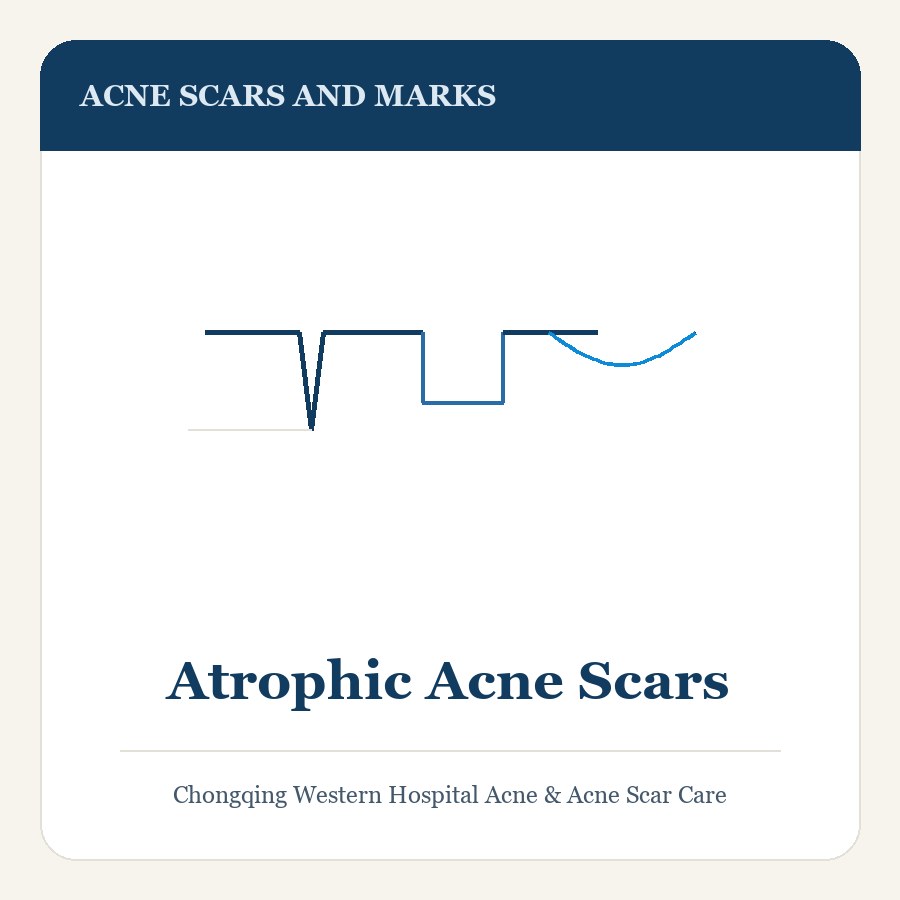
In short. Atrophic acne scars are the indented marks acne leaves behind, and they fall into three shapes: icepick, boxcar, and rolling. The shape, depth, and tethering decide the tool, so a narrow deep tract, a sharply edged pit, and a broad tethered depression each need a different approach. Most faces carry a mixture, which is why single-treatment plans disappoint.
Key points
- Icepick scars are narrow and deep; surface treatment cannot lift the tract.
- Boxcar scars have sharp vertical edges; laser, microneedling, or punch techniques.
- Rolling scars are broad and tethered; subcision releases the bands underneath.
- Most faces carry a mixture, so plans combine focal and surface work.
- A course runs over sessions spaced six to eight weeks apart.
Three shapes, three different problems
Atrophic scars are the dents acne leaves behind, and they fall into three shapes that behave differently. Icepick scars are narrow, deep, and punctate, like a pin pushed into the skin. Boxcar scars are wider, with sharply defined vertical edges, resembling a small punch-out. Rolling scars are broad, shallow depressions with a wavy surface that changes with the direction of the light and stretches when the skin is pulled. Most faces carry a mixture of all three.
How do depth and tethering change the plan?
Different scars sit at different depths and are held in place by different tissue. A narrow deep tract cannot be lifted by a superficial surface treatment, and a broad tethered scar will not improve from resurfacing alone if the tether underneath is still pulling it down. Assessment therefore maps the scar types, depths, distribution, skin thickness, and pigment risk before any treatment is chosen. A device that is excellent for one scar type may do nothing at all for another.
Which treatment matches which scar?
| Scar type | What it looks like | Focal treatment | Broader or surface role |
|---|---|---|---|
| Icepick | Narrow, deep, and punctate, like a pin pushed into the skin | Focal chemical reconstruction into the deep tract; punch techniques for stubborn examples | Little effect on the deep tract |
| Boxcar | Wider, with sharply defined vertical edges, like a small punch-out | Punch elevation or excision when sharply defined and deep | Fractional laser resurfacing; microneedling with or without radiofrequency |
| Rolling | Broad, shallow, and wavy; changes with the light and stretches when pulled | Subcision to release the fibrous bands, often with a filler to support the lift | Fractional laser and microneedling between focal sessions |
| Mixed pattern | Most faces carry a mixture of all three | Planned scar by scar, session by session | Surface treatment across the whole area |
| All types | Depth, tethering, skin thickness, and pigment risk vary | Chosen after assessment, not by scar name alone | Fractional laser and microneedling remodel collagen over broader areas |
The table is a guide to matching, and each session is still planned from what the skin shows that day.
What does a realistic programme look like?
A realistic programme runs over several sessions, usually spaced six to eight weeks apart, mixing focal treatment for specific scars with surface treatment across the whole area. Subcision may be done in one session and fractional laser in the next, with focal chemical reconstruction in another. Each session is planned from what the skin shows that day. Improvement is judged on the course rather than on any single week, and the honest goal is visible smoothing, not the removal of every scar.
Pigment risk and skin tone
Post-treatment darkening is the main risk, particularly in Asian and darker skin tones, and it shapes everything: conservative settings, preparation that stabilises pigment, careful intervals, and strict sun protection before and after. Recovery varies by treatment. Focal work heals within days, while resurfacing and microneedling leave redness and peeling for several days, with sun avoidance for weeks afterwards.
What can treatment realistically achieve?
Scar treatment improves depth, texture, and shadow. It does not restore skin to how it looked before the acne, and no responsible plan promises that. What is realistic is a visible, measurable improvement that most people notice in photographs even when the mirror, examined daily, makes it hard to see.
When should treatment wait?
- Acne is still active: new scars will undo the work and the timing is wrong.
- You have a history of keloid scarring, or of skin that darkens after any injury.
- Isotretinoin has been taken recently: the interval before procedures matters and should be discussed.
Sources
- American Academy of Dermatology — acne scars and treatment information
- British Association of Dermatologists — patient information on acne scarring
- NICE — guidance on the management of acne vulgaris
Frequently asked questions
Why does the shape of an acne scar decide its treatment?
Different scars sit at different depths and are held in place by different tissue. A narrow deep tract cannot be lifted by a superficial surface treatment, and a broad tethered scar will not improve from resurfacing alone while the tether underneath is still pulling it down.
How long does atrophic scar treatment take?
A realistic programme runs over several sessions, usually spaced six to eight weeks apart, mixing focal treatment for specific scars with surface treatment across the whole area. Improvement is judged on the course rather than on any single week, and the goal is visible smoothing rather than perfect skin.
What are the risks of treating indented scars?
Post-treatment darkening is the main risk, particularly in Asian and darker skin tones, and it shapes everything: conservative settings, preparation that stabilises pigment, careful intervals and strict sun protection before and after. Focal work heals within days, while resurfacing leaves redness and peeling for several days.
Risks & Limitations
- Most chronic skin disease is managed rather than cured, and relapse is expected.
- Treatments typically need 8–12 weeks before response can be judged fairly.
- Topical treatment can cause irritation, dryness, peeling and photosensitivity.
- Systemic therapy may require blood monitoring and carries organ, metabolic and pregnancy risks.
- Isotretinoin in particular requires strict monitoring and pregnancy prevention.
- Pigment change is often slow and may be incomplete.
- No treatment works for everyone, and response cannot be predicted with certainty.
When to Seek Care
- A mole or lesion that changes in size, shape or colour, or starts to bleed, itch or crust.
- Fever with a widespread rash, blistering, or rash involving the eyes, mouth or genitals — seek emergency care.
- Rapidly spreading redness, swelling or pain in the skin.
- Facial swelling or difficulty breathing — possible severe reaction; seek emergency care immediately.
- New or worsening symptoms while taking a monitored medication.
References & Further Reading
- American Academy of Dermatology (AAD) — public and clinical guidance
- World Health Organization (WHO) — skin and infectious disease resources
- Chinese Medical Association, Dermatology Branch — clinical guidance
- Cochrane Library — systematic reviews in dermatology
This page is patient education, not medical advice, and it does not cite individual studies. Discuss your own case with a qualified clinician. To arrange an assessment at Chongqing West District Hospital, see Contact & Consultation.